Staged Evidence Photo Analysis · AG Hero Photo
A photograph arranged to tell one story.
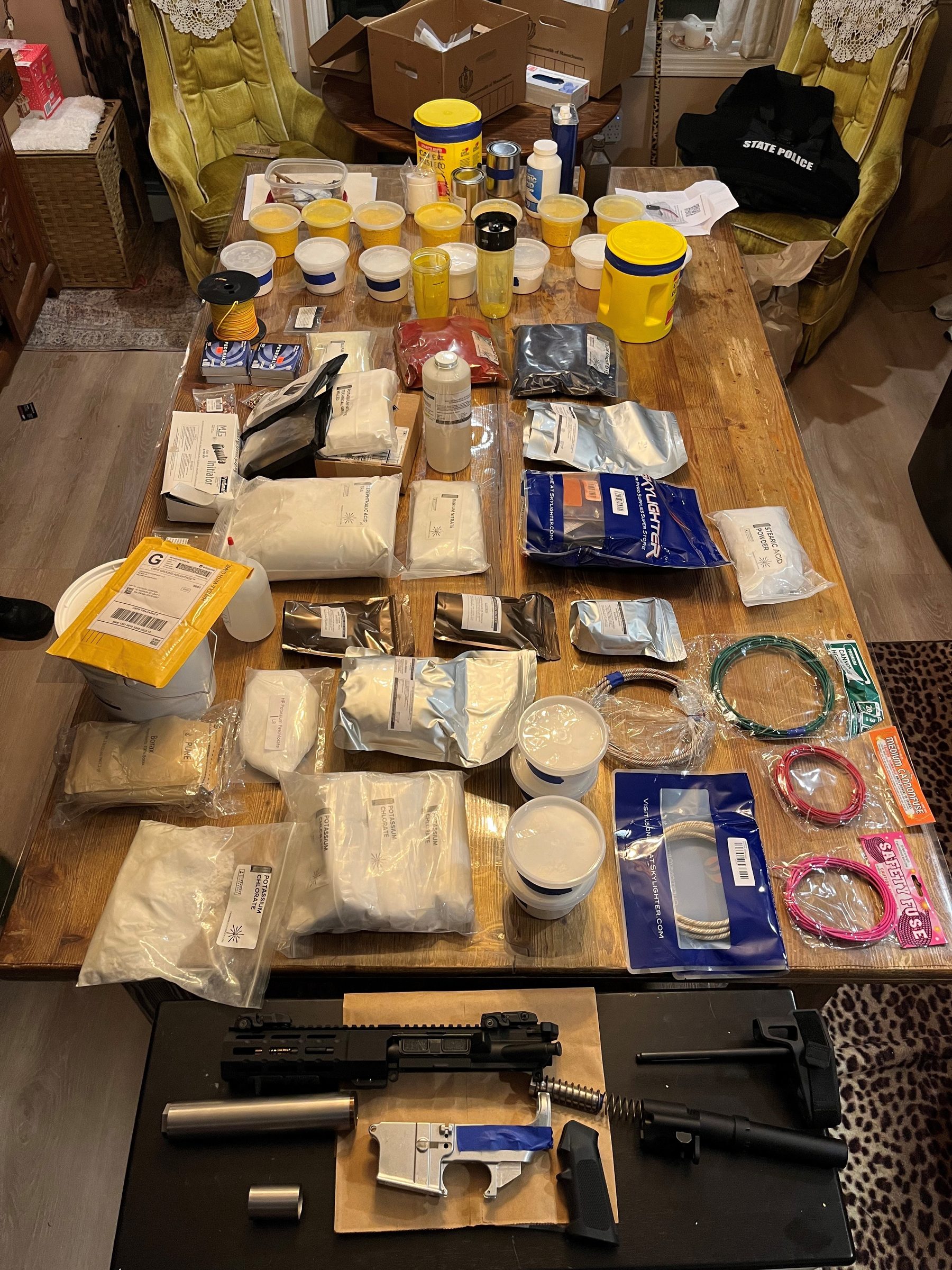
The state's December 23, 2025 release photo was not a snapshot of Patrick Gordon's workshop. It is a staged display, arranged by MSP in Patrick's living room, with every container turned to the camera on purpose. Five patterns appear in the single frame — each independently defensible as happenstance, together not.
Source: Mass. AGO press release, 12/23/2025 · file "12.22.25 EMCD Gordon Takedown.jpg" · EXIF stripped
The Staging Pattern
- ★ Key findingFirearm parts are arranged to suggest a functional weapon that cannot exist from these parts. The "receiver" is an unfinished blank — no magwell cut, no trigger pocket, no fire-control pin holes, no safety selector pocket. There is no trigger or fire-control group anywhere on the table. The "silencer" is an unmodified solvent trap sold as a firearm-cleaning accessory. Nothing in this layout can accept a magazine or fire a round without significant machining. The iPhone was carefully framed at ten feet above the floor to keep that from being visible. Photogrammetry from two caliper-verified objects in the frame puts the lens about ten feet above the floor, pitched exactly 62° downward. Two independent geometric routes, using different objects with different optical properties, agree to within half a degree. For scale: a six-foot adult holding a phone at full overhead extension reaches only about 90 inches above the floor. Producing this frame meant standing higher still — a stepladder, carried into a residential dining room and climbed. 62° is the one angle that sights straight down the top of the receiver, where a machined magwell and a solid unmachined blank are indistinguishable. The height and the angle were not incidental. They were chosen to hide the unmachined magwell. From almost anywhere else in that room, the camera would have shown an unfinished blank.
- Exculpatory factory labels are physically rotated away — Fireworks Cookbook sodium silicate (water glass, a fireproofing agent) and the CA glue bottle both have their product labels turned from the camera.
- Hobbyist smoke-composition labels are blank or back-facing — the blue painter's-tape identification labels either rotated away or showing no writing.
- ★ Evidence tamperingThe labels were removed and the containers re-taped blank. The white ½-lb deli containers (inventory items 9 and 10) held an incomplete mix — 14 parts powdered sugar to 6 parts magnesium carbonate, no oxidizer added — stored sealed mid-mix, oxidizer last as a safety step. Each container was labeled in Sharpie “Powdered Sugar.” In the photo the camera-facing blue painter's tape is blank — not one of those labels is visible. The labels were removed at the scene and the containers re-taped with blank blue painter's tape. That roll of blue painter's tape is not on the state's sworn 43-item inventory and does not appear in the photograph — so the tape used to blank the labels came from a source the state never logged. Source: direct phone conversation with Patrick, October 24, 2026. Supporting audio — phone call with Patrick, 10/24/2026
- Scary-sounding product labels are rotated forward — potassium chlorate on four separate bags, perchlorate, barium nitrate, "MEDIUM CANNON FUSE."
- Safety-named items are not on the inventory at all — a pink package reading "SAFETY FUSE," the CA glue bottle, and the Firewire remote-ignition hookup appear in the photograph but have no line in the state's sworn 43-item list.
File provenance & how we know the frame is uncropped
The filename
The AG's office published the image at mass.gov/files/2025-12/12.22.25 EMCD Gordon Takedown.jpg. It decodes cleanly: 12.22.25 is the raid date. EMCD is the AGO's Enterprise and Major Crimes Division — the division where AAG Diana Fantasia prosecutes, under Chief Jennifer Kirshenbaum. “Gordon Takedown” is the office's own internal description of the file, written before any adjudication of any charge.
Native resolution
The published file is 3024 × 4032 pixels — 12.19 megapixels, aspect ratio exactly 4:3 (4032 ÷ 3024 = 1.33333). That is the standard full-sensor still output of the iPhone main camera, unchanged from the iPhone 6s through current models, and the output of Pro models shooting in binned 12 MP mode. Portrait orientation.
Why the frame is uncropped
Any crop removes pixels. This file carries the full native pixel count in both axes, with the sensor's exact 4:3 ratio intact. For it to be a crop and still measure 3024 × 4032, it would have to have been cropped and then resampled back up to native dimensions — an unusual extra step that leaves interpolation signatures a forensic examiner can detect: softened edge transitions, altered noise statistics, and absent per-pixel sensor detail.
This is not a trivial point. The camera-position measurement depends on the full field of view being present. A cropped frame has a narrower effective field of view, which raises the focal length in pixels and changes every distance derived from it. Establishing that the frame is whole is what makes the geometry usable.
The geometry corroborates the lens on its own
3024 × 4032 is also the output of the iPhone ultra-wide camera, so resolution alone does not identify which lens was used. The scene geometry settles it. Solved at ultra-wide focal length (~1510 px), the equations return a camera pitch beyond 90° — the lens aimed backward past straight down — which is physically impossible. Solved at the 1× main-camera focal length (~3029 px), two independent objects agree to within half a degree. Telephoto is excluded by framing: the shot takes in the whole table, two chairs, cartons and a window.
What was modified
Pixel dimensions show no sign of alteration. Metadata does not survive. All EXIF, XMP and IPTC data is stripped from every published copy — mass.gov, CBS Boston, and the Boston Globe alike. No camera make or model, no capture timestamp, no GPS, no lens identification, no software history.
Stripping is consistent with a routine CMS re-encode, and it is also exactly what deliberate scrubbing looks like. The published file cannot distinguish the two. One check can: JPEG quantization tables. Apple's encoder writes distinctive tables; a Drupal or CDN re-encode writes different ones. Comparing them indicates how many times the file was re-saved and by what software.
Why the native file is a discovery ask
The original in-camera file would supply the camera make and model — eliminating the remaining lens ambiguity outright — along with the capture timestamp for cross-check against the warrant return, and possibly GPS coordinates inside the apartment. Demanding it, with hash and chain of custody, is already on the defense list. This analysis adds a second reason to press for it.
Your edits autosave to this browser. Drag empty space to draw a box · drag to move · drag the corner to resize · fields apply to the selected region. Video is a path to an .mp4 published alongside this artifact (e.g. media/clips/srds-kclo4-ca-prime-demo.mp4); start/stop are optional and append a #t=S,E fragment so the embedded player opens at that range. Export to send a copy or make a snapshot. The six staging-tell hotspots (SAFETY FUSE, CA glue, Firewire firing line, 9V connector, MSP vest, evidence boxes) are positioned on their subjects and highlight together on hover.
Interactive photo
Press and hold any outlined itemClick any item on the table
Keep your finger still for a moment and its details open: what it really is, and how it was staged. Swiping and pinching still move the photo.Move over the photo to find each item; click it to see what it really is, and how it was staged.
Look closer.
This is the Attorney General’s photograph at its native 3024 × 4032 pixels, unaltered. Drag to pan. Double-click, tap +, or pinch to zoom, up to six times past native resolution, so you see the real pixels and nothing the camera did not record. Hold Ctrl or ⌘ and scroll to zoom with the wheel.
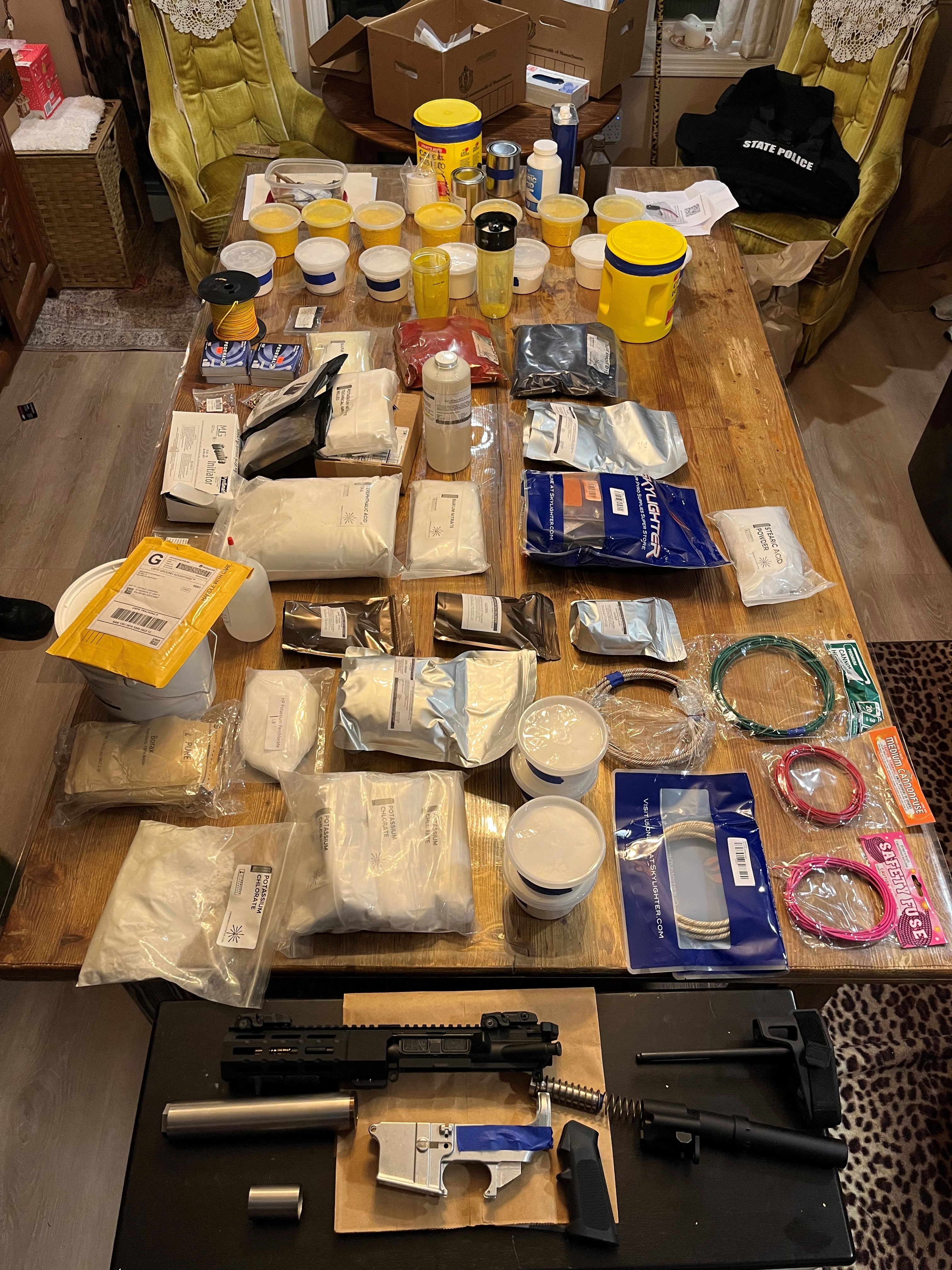
Published by the Massachusetts Attorney General’s Office at
mass.gov/files/2025-12/12.22.25 EMCD Gordon Takedown.jpg.
The file carries no embedded camera metadata. The AG’s server reports it last modified Tue, 23 Dec 2025 21:11:59 GMT.
The download above is byte-identical to the published file (4,141,825 bytes).
SHA-256 3121d9b97aed1a2736700a5aa60a90d905793a0a26de2dbb665fc2b495510412
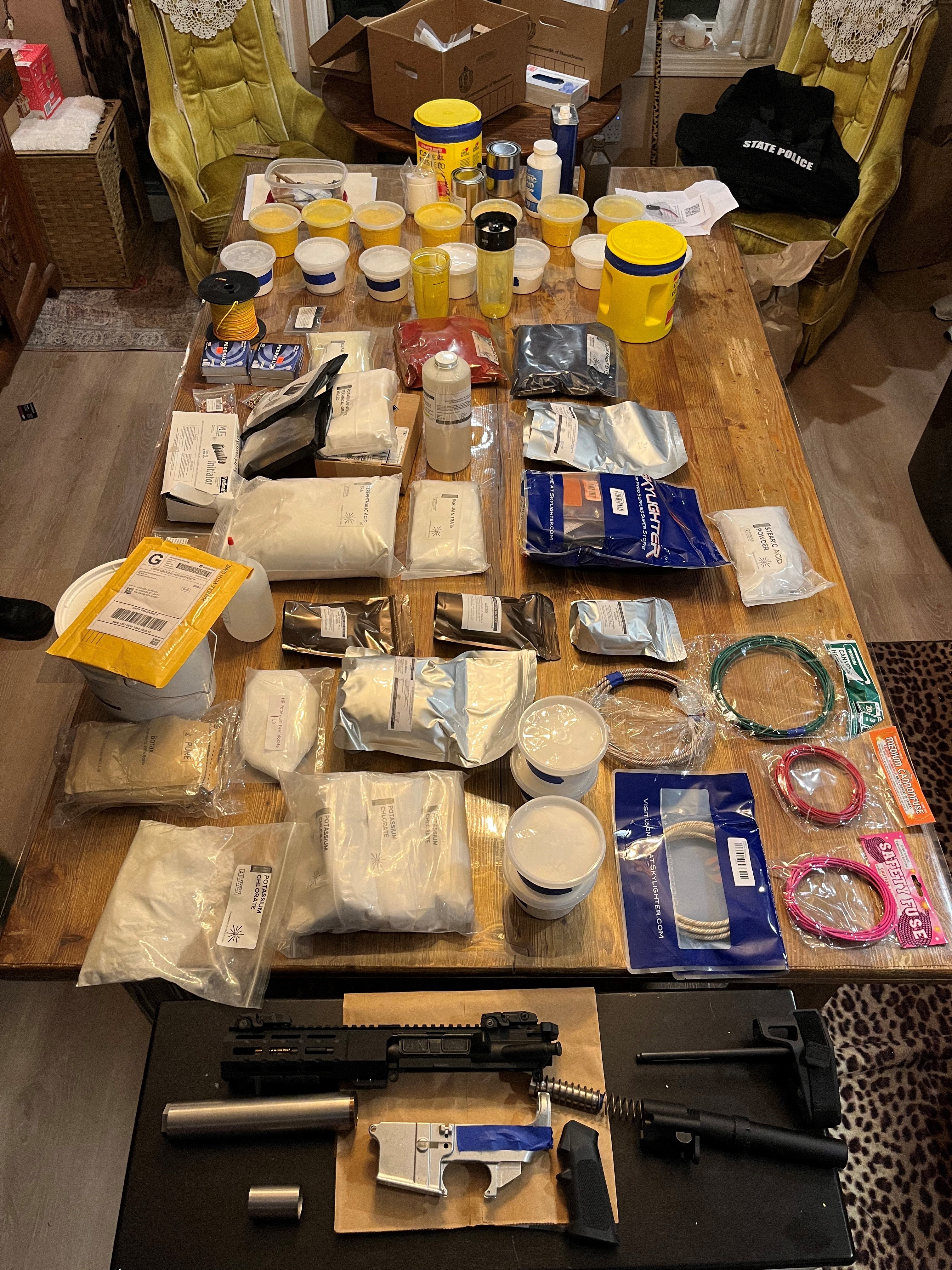
Where this file comes from
- Published by
- Massachusetts Attorney General’s Office, at mass.gov/files/2025-12/12.22.25 EMCD Gordon Takedown.jpg, with its press release dated 12/23/2025.
- File
- JPEG, 3024 × 4032 pixels, 4,141,825 bytes.
- Camera metadata
- None. The file holds no EXIF, XMP, or GPS data, so it records no capture time, camera, or location. The metadata was removed, or the image was re-encoded, before publication.
- Uploaded to mass.gov
- The AG’s server reports the file last modified Tue, 23 Dec 2025 21:11:59 GMT (4:11:59 PM EST). A resized copy of the same image was generated 62 seconds later. That dates the upload, not the moment the photo was taken.
- Release page time
- The release shows a date only (12/23/2025). No time of day, and no “last updated” entry.
- Independent copy
- The Internet Archive saved this image on 24 Dec 2025 at 11:42:11 UTC (6:42 AM EST): archived copy. That archived file is byte-for-byte identical to the one on mass.gov today.
- Fingerprint
SHA-256 3121d9b97aed1a2736700a5aa60a90d905793a0a26de2dbb665fc2b495510412- This copy
- The viewer above and the download are that same file, unaltered. Nothing has been upscaled, sharpened, or enhanced.

What is still unknown: when the photo was actually taken, and by whom. The camera original, with its embedded metadata, has not been produced.